Live events bring people together through shared experiences, whether at a theater, festival, sporting event, museum, university or music venue. Behind those experiences, event ticketing systems play an important role in how audiences discover events, purchase tickets and interact with organizations.
The global online event ticketing market is projected to reach $131 billion by 2033, up from $72 billion in 2026, according to Grand View Research. As the market grows, organizations have more ticketing platforms and capabilities to choose from. Today’s systems can extend well beyond ticket sales to connect payments, audience data, marketing, reporting and other areas of event operations.
In this blog we’ll look at 10 event ticketing systems and how they compare. We’ll cover criteria for selecting the best event ticketing software along with each solution’s key features and pricing.
What is Event Ticketing Software?
Event ticketing software helps organizations create and manage events, sell and distribute tickets, process payments and manage admissions. Depending on the platform, it can also support marketing, reporting, fundraising, customer relationship management and other areas of event operations.
For organizations managing multiple events and audiences, these systems can also help teams share information and reduce the need to move data manually between disconnected tools. More advanced platforms may connect ticketing data with marketing, audience insights, fundraising and other workflows.
Museums, universities, performing arts companies, music venues, festivals, attractions and sports organizations all use event ticketing software to manage events and ticket sales.
What are the Benefits of Using an Event Ticketing System?
Live event ticketing systems can make ticket sales and event management more efficient while giving organizations a better view of their customers and operations. While most modern systems provide the fundamentals required to sell and manage tickets, more advanced capabilities can create additional value across the organization.
Core Ticketing Capabilities
Depending on the organization and event type, core capabilities may include:
- Online and box-office ticket sales
- Mobile-friendly checkout and digital ticket delivery
- Payment processing
- General admission, reserved seating and capacity management
- Tiered pricing, discounts and promo codes
- Ticket scanning and attendance management
- Customer and order information
- Sales and attendance reporting
- Branded event and checkout experiences
These capabilities make it easier for organizations to manage ticket sales while giving audiences a convenient way to purchase and access tickets.
Capabilities That Can Create More Value
Ticketing data can be useful well beyond the initial transaction. When it connects with other areas of the organization, it can help teams understand audience behavior, improve marketing, identify opportunities for growth and operate more efficiently. Capabilities that support this include:
- CRM and connected first-party audience data
- Audience segmentation and insights
- Email, SMS and other marketing capabilities
- Marketing attribution and campaign automation
- Advanced reporting and real-time performance insights
- Memberships, subscriptions and fundraising
- Integrations and APIs that connect systems and workflows
- Tools that improve the purchase and checkout experience
- Fraud prevention and payment security
- Event-day and onsite commerce capabilities
- Tools that help teams share data and operate more efficiently
Bringing more of this information together can also reduce the operational challenges created by disconnected systems.
Types of Event Ticketing Software
Event ticketing platforms use a range of pricing models, and many now combine several types of fees rather than fitting neatly into a single pricing category.
Common pricing approaches include:
- Subscription pricing: Organizations pay a monthly or annual fee for access to the platform or a particular set of capabilities.
- Per-ticket fees: The provider charges a fixed amount for each ticket sold.
- Percentage-based fees: The provider charges a percentage of the ticket price or transaction total.
- Payment processing fees: Credit card and other payment-processing charges may be included in the ticketing fee or charged separately.
- Custom or enterprise pricing: Larger organizations may negotiate pricing based on ticket volume, products, services or organizational requirements.
Many platforms use a combination of these models. Some also allow organizers to absorb fees or pass some costs on to ticket buyers.
When comparing pricing, consider the total cost rather than a single advertised fee. Payment processing, subscriptions, optional features and the capabilities included in each plan can all affect the overall cost.
The Best 10 Event Ticketing Software Systems
Organizing a live event is a significant undertaking. When different teams use separate systems, sharing information can become difficult and create additional work. Ticketing platforms can help centralize ticket sales and event management, while more advanced systems may also connect customer data, reporting, marketing and other operational functions.
Below are 10 established event ticketing software systems, along with their current features and pricing.
1. AudienceView
AudienceView is a unified event commerce platform that brings ticketing, payments, digital marketing, audience intelligence and event operations together in one platform. For organizations looking beyond standalone ticketing, that connected approach can create value across the organization. Connected data gives teams a clearer understanding of their audiences and the activity driving revenue, while making it easier to create relevant marketing, strengthen audience relationships and reduce the operational work created by disconnected systems. The solution offers a breadth of capabilities including reserved seating and flexible pricing, memberships and subscriptions, fundraising, reporting, audience segmentation, email and SMS marketing, campaign automation, revenue attribution and more.
Pricing: Contact AudienceView directly for pricing information.
2. Eventbrite
Eventbrite combines self-service event creation and ticketing with a large consumer event marketplace, giving organizers a built-in channel for reaching people searching for events. It also includes flexible ticket types, attendee management, email and social marketing, advertising tools, analytics and reporting, along with more than 100 apps available through its marketplace. That combination of ticketing and consumer discovery remains one of Eventbrite’s clearest benefits, particularly for organizers looking to reach audiences beyond their existing customer base.
Pricing: Free events have no ticketing fees. For paid tickets in the U.S., Eventbrite currently charges a 3.7% + $1.79 service fee per ticket and a 2.9% payment-processing fee per order. Fees are generally paid by ticket buyers unless the organizer chooses to cover them.
3. Bizzabo
Bizzabo’s Event Experience OS is designed primarily for professional, corporate and B2B events. It combines ticketing and registration with contact management, email campaigns, event websites, advanced registration flows, a mobile app, reporting and analytics. Bizzabo also offers Klik SmartBadge technology for onsite networking and lead capture. Its broad event-management and experiential capabilities make it particularly suited to organizations managing substantial event programs, although its annual subscription represents a significantly higher entry price than many of the self-service ticketing platforms on this list.
Pricing: Bizzabo currently costs $499 per user per month billed annually, with a three-user minimum and plans starting at $17,999 per year.
4. Ticketbud
Ticketbud combines self-service ticketing with custom event pages, registration questions, promo codes, timed entry, attendee management, mobile ticket scanning and reporting. It supports Stripe and PayPal and gives organizers ownership of their event and attendee data. Its relatively straightforward model, with no subscription tiers for its core platform, makes it an accessible option for organizers that don’t need the broader audience, marketing and operational capabilities of a more extensive event commerce platform. Ticketbud also offers flexible payouts and discounted rates for eligible nonprofits and schools.
Pricing: Paid events currently cost 2% + $0.99 per ticket, plus payment processing, with a reduced rate of 1.75% + $0.99 for eligible nonprofits and schools. Free events are free.
5. ThunderTix
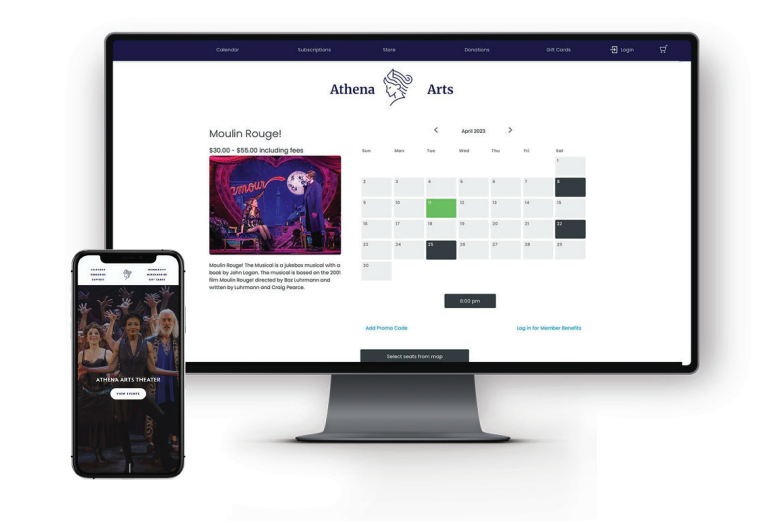
ThunderTix provides online and box-office ticketing for performing arts organizations, music venues, festivals, schools and other live events. Its capabilities include general admission and reserved seating, interactive seating charts, season subscriptions and packages, donations, gift cards, customer management and reporting. Its support for recurring performances, seasons and patron management distinguishes it from platforms focused primarily on one-off events, while integrations and an API allow organizations to connect ticketing with other marketing and operational systems.
Pricing: General Admission currently costs $20 per month and includes the first 20 tickets, with additional tickets at $1 each. Reserved Seating costs $25 per month and includes the first 20 tickets, with additional tickets at $1.25 each. ThunderTix does not charge a percentage of ticket sales.
6. Eventcube
Eventcube combines ticketing and event registration with membership and virtual-event capabilities. It supports paid and free tickets, discounts and promotions, branded ticketing experiences, seating plans and integrations with other systems. The addition of membership management gives it applications beyond individual ticket transactions, while its tiered model provides a low-barrier starting point with additional customization and integrations available through Pro and Enterprise plans.
Pricing: Starter has no monthly subscription and currently charges 5% of the transaction total plus payment processing. Pro costs $125 per month, or $99 per month billed annually, with a 3% transaction fee. Enterprise pricing is customized.
7. TicketSpice
TicketSpice provides online and onsite ticketing with extensive customization options, including a ticketing-page builder, timed entry, recurring events, reserved seating, donations, merchandise, mobile scanning and box-office sales. Organizers can also add email and SMS marketing, drip campaigns, data enrichment and cashless onsite payments. Its modular approach and flat platform fee can give organizers flexibility to customize the ticketing experience and add more advanced marketing or onsite capabilities as needed.
Pricing: Standard online tickets over $5 currently carry a $0.99 per-ticket fee, while tickets priced at $5 or less cost $0.49. Payment processing and optional premium capabilities carry additional fees.
8. Purplepass
Purplepass provides online and box-office ticketing for a broad range of event types, with capabilities including assigned seating, season subscriptions, packages and flex passes, donations, fundraising, reporting and marketing tools. It also supports tiered pricing, group discounts, merchandise, add-ons and SMS marketing. Its combination of traditional box-office functionality with flexible packages and season-ticket options makes it relevant for organizations running recurring events as well as individual performances or events. Purplepass also provides 24/7 U.S.-based phone support.
Pricing: Purplepass currently lists online ticketing at 2.5% + $0.99 per ticket, with a reduced nonprofit rate of 2% + $0.99. Payment-processing fees may also apply.
9. ezEvent
ezEvent provides online and box-office ticketing for promoters, venues and event organizers, including digital ticket delivery, barcode scanning, reporting, customer marketing tools and reserved seating. Organizers can create venue seat maps, offer different ticket types and add-ons, and use customer information for future marketing. One distinguishing feature is its PayPal-based payment model, which allows ticket revenue to be deposited into the organizer’s account as sales occur rather than requiring organizers to wait until after the event.
Pricing: Service fees for paid tickets currently start at 1% of the ticket purchase price + $0.50 per ticket, with separate PayPal payment-processing fees. Free events are free.
10. Tix
Tix provides online and box-office ticketing with reserved seating, season packages, customer management and email marketing, donations, reporting, mobile ticketing and barcode scanning. It also supports private-label ticketing pages and gives organizations the option to use their own compatible merchant account or Tix’s merchant account. Its relatively simple per-ticket pricing, combined with traditional box-office and reserved-seating capabilities, provides an alternative to platforms built around monthly subscriptions. An optional call-center service also supports telephone ticket sales.
Pricing: Tix currently charges $0.25 per box-office ticket and $1.50 per online ticket, with no setup, monthly or annual fees. Additional fees apply for some payment-processing options and its optional call-center service.
How to Choose the Right CRM Ticketing Software
Most ticketing software can handle the fundamentals of selling tickets, but the capabilities surrounding the transaction can vary considerably. The right platform should support the way your organization operates today while giving you the flexibility to meet changing audience and operational needs.
Some questions to ask when evaluating ticketing software include:
- Does the platform support the event types, seating models and sales channels you need?
- How easy is the software for staff to use?
- What does the checkout experience look like for audiences, particularly on mobile?
- Does the pricing structure align with your needs and ticket volume?
- Can the platform support donations, fundraising, memberships or subscriptions if you need them?
- Can you segment audiences and use ticketing behavior to create more relevant communications?
- Can teams easily access and use ticketing and audience data?
- Who owns your data, and how easily can you export or access it?
- Does the platform integrate with your marketing, fundraising, finance and other important systems?
- What audience insights, reporting and marketing attribution capabilities are available?
- Is the system customizable and can you maintain your organization’s branding?
- Can the platform scale with your organization and event volume?
- How does the provider approach security and fraud prevention?
- Can teams work efficiently without relying on disconnected systems or manual data transfers?
Consider both the capabilities you need today and how the platform could support your organization as your audiences, events and operations evolve.
What is the Easiest Event Ticketing Software to Use?
The easiest event ticketing software to use will depend on the organization, its events and the people using the system. A self-service platform designed for occasional events may have very different requirements from a system supporting reserved seating, subscriptions, fundraising, audience segmentation and multiple departments.
Ease of use should also consider the experience for ticket buyers. When evaluating a platform, ask about onboarding and training, test the workflows staff use most often and walk through the ticket-purchasing experience from the audience’s perspective.
Which Ticket Site Has the Lowest Seller Fees?
Ticketing platforms use different combinations of per-ticket charges, percentage-based fees, payment-processing costs and subscriptions, so there isn’t one fee structure that will be lowest for every organization.
Ticket price and sales volume can make a significant difference to the total cost. Organizations should also consider whether fees can be absorbed or passed to buyers and whether additional products or services are required to get the functionality they need.
Price is only one part of the equation. Comparing total cost alongside capabilities, integrations, audience experience, operational efficiency and access to data can provide a more useful picture of a platform’s overall value.
Streamline Ticket Sales for Your Next Event
The right event ticketing system can support much more than the ticket transaction. When ticketing, payments, audience data, marketing and event operations are connected, teams can work more efficiently, gain a clearer understanding of their audiences and create better experiences throughout the event journey.
AudienceView is a unified event commerce platform that connects audiences, operations and engagement across the live event journey. By bringing together ticketing, payments, digital marketing, audience intelligence and event operations, AudienceView helps live event organizations better understand, engage and grow their audiences.
Check out our Ultimate Guide to Buying Ticketing Software before you choose the best ticketing software for your organization.