Every ticket sold provides insight into how an audience responds to price. Looking at what people are willing to pay, when they buy and how they respond to promotions can help live event organizations make better decisions about what to charge, when to protect price and when an incentive might help drive demand.
AudienceView’s 2026 Annual Ticket Buyer Report draws on research across audiences, price points and live event experiences. Together, those findings provide a broader view of how audiences respond to price, revealing patterns that can help organizations better understand and evaluate what they’re seeing in their own ticketing data.
In this article, we’re sharing some of the most useful pricing insights from that research, along with the questions organizations can ask of their own ticketing data to better understand demand and build a stronger pricing strategy.
Price Can Tell You When Audiences Are Likely to Buy
AudienceView’s research shows a clear relationship between ticket price and how far in advance audiences tend to commit.
Tickets priced at $200–$250 are most often purchased one to six months before an event and show relatively little last-minute activity. Tickets around $100 tend to peak one to two months out, while $10–$20 tickets are typically purchased during the final week or on the day of the event.
![$200–$250 tickets → most often purchased 1–6 months out
~$100 tickets → peak 1–2 months out
$10–$20 tickets → typically purchased final week/day-of]](https://audienceview.com/wp-content/uploads/sites/2/2023/04/Screenshot-2026-10-23-at-16.57.07.png?w=640)
That matters because the same sales pace can mean different things at different price points. A premium event may naturally capture more of its demand early, while lower-priced inventory may continue moving much closer to the event.
Questions to ask of your own ticketing data:
- How far in advance do our highest-value buyers commit?
- How does purchase timing change across our price bands?
- Which price points continue selling close to the event?
- Do certain events have consistently longer or shorter purchase windows?
Different Events Support Different Price Points
What audiences are willing to spend also varies considerably by the kind of experience they’re buying.
The 2026 research found reported ticket prices ranging widely across event types. Opera sits at the top of the range at $150, with musicals at $120, orchestras/symphonies at $110, concerts at $100 and several other categories at different levels. The report connects those differences with purchase timing: events people commit to earlier tend to support higher ticket prices.
This is where an organization’s own data becomes particularly useful. Rather than relying on a single average ticket price, teams can compare price and purchasing behavior across productions, genres, artists and event types to understand where audiences demonstrate greater willingness to pay.
Questions to ask of your own ticketing data:
- Which event types consistently support our highest ticket prices?
- Which events sell strongly even as prices increase?
- Where do we see greater price sensitivity?
- Does willingness to pay change by audience segment, genre or type of experience?
Sales Velocity Can Tell You When to Protect Price and When to Promote
Purchase timing can also help organizations understand when a pricing intervention may actually be necessary.
A slower period in the sales cycle doesn’t automatically mean an event needs a discount. Every organization has its own sales curve, and different events may build demand at different points. Looking at how quickly inventory is selling, at what price and how that pace compares with similar events can provide important context before changing price.
At Blumenthal Arts, Revenue Optimization Manager Lee LaBorde and her team began monitoring purchase timing more actively to understand when audiences were actually responding. That helped inform decisions about when to put marketing dollars behind an event rather than relying on a predetermined calendar.
“We started monitoring purchase timing more actively. That has helped make decisions on how our team spends marketing and when they’re spending those allocated marketing dollars.” — Lee LaBorde, Revenue Optimization Manager, Blumenthal Arts
The same principle can be applied to pricing. The 2026 Annual Ticket Buyer Report found that higher-priced buyers tend to purchase earlier and specifically recommends protecting premium sales windows before offering discounts.
Looking at sales velocity alongside price can help teams distinguish between a normal lull in demand and a point at which an offer, price adjustment or additional promotion may be useful.
Questions to ask of your own ticketing data:
- At what point does full-price demand typically begin to slow?
- Is a mid-cycle sales lull normal for this kind of event?
- When have promotions actually changed sales velocity?
- Are we discounting inventory that historically would have sold at full price?
- How does the current sales curve compare with similar past events?
Discounts Can Drive Attendance, but Not Every Buyer Needs One
AudienceView’s Insights Series adds another important dimension to the pricing picture.
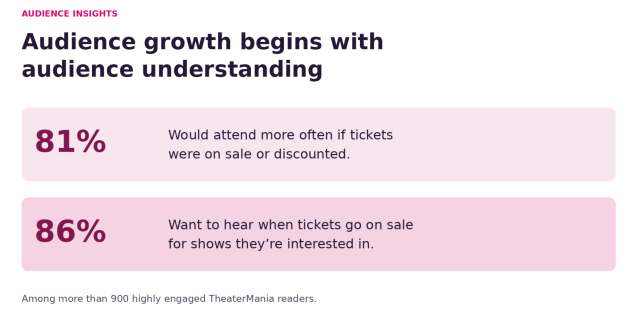
Among more than 900 highly engaged TheaterMania readers, 81% said they would attend more often if tickets were on sale or discounted. At the same time, 86% want to hear when tickets go on sale for shows they’re interested in.
Those findings show considerable interest in both offers and timely communication. Ticketing data can help organizations go further by determining which audiences actually respond to a price incentive and which were already likely to purchase.
Questions to ask of your own ticketing data:
- Which audience segments respond most consistently to discounts?
- Which buyers typically purchase at full price?
- Do promotions generate incremental sales or shift existing buyers to a lower price?
- Which offers increase attendance without unnecessarily reducing ticket yield?
- When in the sales cycle are promotions most effective?
The Price Audiences Experience Includes Fees
Ticket price isn’t the only number audiences consider when deciding whether to complete a purchase.
In the 2026 Ticket Buyer Report, 26% said fees that weren’t a surprise but were too high were their most common reason for abandoning an online ticket purchase. Another 18% cited fees that were both unexpected and too high. And 61% of buyers said clearer pricing and fees would make it easier to complete their purchase.
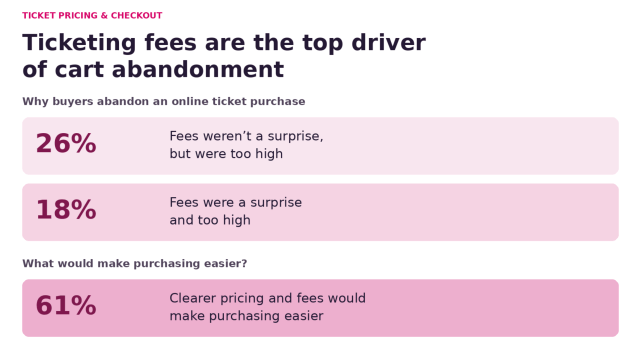
That’s useful pricing intelligence. Looking at base ticket price without looking at the total amount presented at checkout can give an incomplete picture of what buyers are responding to.
Questions to ask of your own ticketing data:
- Where in the purchase journey are buyers abandoning?
- Does conversion change as the total checkout price increases?
- Are particular price levels or events seeing higher abandonment?
- What percentage of the buyer’s final cost comes from fees?
- Could clearer pricing reduce friction without changing the underlying ticket price?
Turn Raw Ticketing Data Into Pricing Intelligence
AudienceView’s research provides useful benchmarks for understanding how audiences respond to price, but the most valuable insights will come from combining those broader patterns with what you know about your own audiences.
Purchase timing, sales velocity, event type, promotional response and conversion can all provide clues about what audiences are willing to pay and when pricing may need to change. Looking at those signals together can help teams move beyond relying on historical pricing or instinct alone and build a strategy based on how their audiences actually buy.
As Lee LaBorde explains, the goal is to turn the information organizations already have into something they can act on:
“Start small. What is that persistent question or thing that kind of bugs you? Chase it. Our job is to be curious. We see the end result. How did we get there?”
Sometimes the most valuable insights don’t come from collecting more data. They come from asking better questions of the data you already have.
AudienceView connects ticketing and audience data, helping live event organizations better understand purchasing behavior, identify meaningful patterns and use those insights to inform pricing, marketing and revenue strategy.