The modern patron journey rarely begins at the box office.
Long before someone selects a seat or enters their payment information, they may have encountered an event in an email, heard about it from a friend, searched for something to do, or discovered it while scrolling through social media.
Each of those moments contributes to a potential ticket purchase. And increasingly, understanding how audiences move between them is becoming an important part of audience intelligence.
AudienceView research into more than 900 highly engaged theatregoers offers a closer look at the behaviors and expectations of some of live entertainment’s most committed patrons. While these audiences don’t represent every ticket buyer, their behavior provides useful signals about what keeps people discovering, purchasing and returning to live experiences.
For live event organizations, the opportunity is to look beyond the final transaction and understand the entire journey that led to it.
The Patron Journey Starts With Discovery
There is no single place where audiences discover their next live experience.
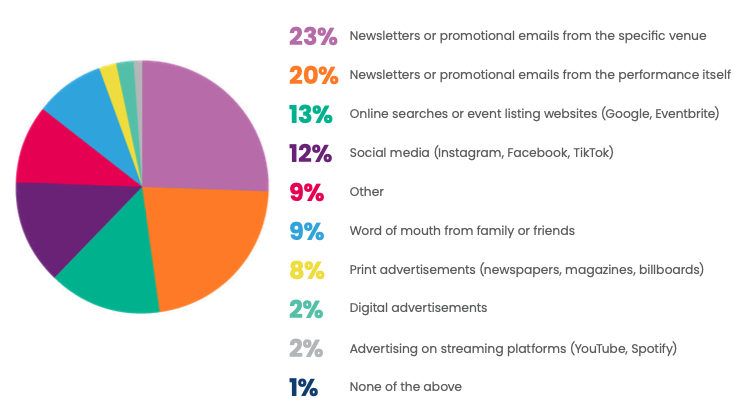
Among the highly engaged audiences surveyed, newsletters and promotional emails were the most commonly cited discovery source at 23%, while advertising or streaming platforms were among the least common at just 2%.
But the more interesting insight may be how those preferences change across audiences.
The research found that people under 40 are more likely to use social media to discover events and less likely to subscribe to newsletters. The report recommends leaning more heavily into social promotion when programming is likely to appeal to younger audiences, while email may play a larger role for older audiences.
Different audience segments also show different discovery tendencies. The page-two infographic, for example, shows Culture Cravers leaning toward email, Music Lovers toward social, Action Seekers toward search and Avid Learners toward word of mouth.
That makes discovery an audience intelligence question, not simply a channel question.
Rather than asking, Which marketing channel works best?, organizations can ask a more useful question:
Which channels work best for the audiences we are trying to reach?
Every Digital Touchpoint Can Influence the Decision to Attend
Discovery gets someone interested. What happens next can determine whether that interest turns into attendance.
A potential patron may move from social media to an event page, leave and return through search, open an email several days later and eventually navigate directly to the venue’s website to purchase.
That means marketing channels shouldn’t be evaluated only by whether they generated the final click.
The website, event information, pricing and purchase experience all become part of the same journey. If information is difficult to find or the path to purchase feels disconnected from the experience that initially generated interest, organizations risk adding friction at precisely the moment someone is deciding whether to attend.
Audience intelligence helps connect those signals.
Looking at the channels people use to discover events, the content they engage with and how they ultimately purchase can give organizations a clearer picture of what is influencing conversion, even when the journey spans multiple touchpoints.
The Website Remains a Critical Part of the Purchase Journey
Even as discovery becomes more distributed, the venue or organization’s own digital experience remains important.
More than half of the highly engaged patrons surveyed, 56%, said they usually purchase tickets online directly from the venue or performance. Another 20% typically purchase online through a third party, while 15% purchase in person or over the phone through the box office. Only 1% reported usually purchasing through social media links.
That distinction matters.
Social media, search, email and word of mouth can all help generate demand, but the organization’s own website may still be where a significant portion of that demand turns into revenue.
For organizations, that means the website shouldn’t simply function as a place to process transactions. It is part of the audience experience.
Event information should be easy to find. The path from discovery to purchase should feel intuitive. And the experience should give potential patrons the clarity and confidence they need to make a decision.
Timing Is Another Audience Signal
Understanding when audiences purchase can be just as useful as understanding where they purchase.
Among respondents, 26% typically purchase tickets one to two months before an event, while only 5% purchase on the day of the event.
For marketers, purchase timing can help inform when and how campaigns are activated.
Instead of treating every potential attendee the same way from announcement through event day, organizations can use historical behavior to understand when different audiences are most likely to act.
Early planners may respond to one message or offer, while audiences who typically make decisions closer to the event may need something entirely different.
The goal isn’t simply to send more messages. It’s to recognize the signals that indicate where someone may be in their journey and make the next interaction more relevant.
There Is No One Modern Patron Journey
Perhaps the most useful takeaway from the research is that there isn’t a universal path from awareness to attendance.
One patron discovers an event through Instagram. Another opens a newsletter. Someone else hears about it from a friend and searches for it later.
They may ultimately arrive at the exact same checkout page, but the journeys that brought them there can look completely different.
For live event organizations, understanding those differences creates an opportunity to make smarter decisions across marketing, digital experience and ticketing.
Start by asking:
- Where are different audience segments discovering our events?
- Which touchpoints appear before a purchase?
- When do different audiences tend to buy?
- Where does the journey create unnecessary friction?
- How can what we learn from one interaction improve the next?
The modern patron journey isn’t defined by a single channel or transaction. It is the accumulation of signals audiences leave as they discover, consider and ultimately choose an experience.
Organizations that learn to read those signals can do more than understand how a ticket was sold. They can understand what moved someone from interest to attendance and use that intelligence to create a stronger journey the next time around.
Want to dig deeper into what today’s audiences value? Explore the latest findings from the AudienceView Insights Series for more insights into audience behavior, preferences and engagement.